Not a cut-down version
You get the real thing — the SDK in your app, recorded sessions, bug reports with severity, the fix loop. Credits buy tester seats, not a demo tier.
Solo devs here test each other’s apps — because you will never find your own bugs.
You know where everything is, so you cannot see what a stranger sees. Friends install once, tap around, then ghost. Here you test somebody else’s app, earn credits for the testing you actually did, and spend them on testers for your own — no money involved. If you would rather pay than test, that works too.
How it works ↓Builders here test each other's apps. You earn credits by testing someone else's app and spend them on testers for your own — the way to clear Google's 12×14 closed-test requirement without paying for it. Same platform, same SDK, same evidence: the only thing that changes is what you pay with.
You get the real thing — the SDK in your app, recorded sessions, bug reports with severity, the fix loop. Credits buy tester seats, not a demo tier.
A test day only pays when a real session backs it, and never on your own app. That is the whole difference to the swap groups: here the testing has to have happened.
Got a launch date? Pay and get testers now. Got time instead? Test for two weeks and earn a seat. Both run on the same platform, so switching costs you nothing.
The exchange opened in August 2026 and is still small — you would be among the first in it, which means finding a match takes a little patience. And a fair warning: Google introduced the 12×14 rule to stop rings of developers waving each other through. Reciprocal testing is fine as long as the testing is real, which is exactly the part we measure and keep evidence of.
Old engineering rule, truer than ever: the first 90% of the code takes 90% of the time — the remaining 10% takes the other 90% (Tom Cargill, Bell Labs). AI collapsed the first part into days. What is left is exactly the part no prompt can skip: the edge cases, the crashes on someone else's phone, the flows only a stranger gets lost in.
Every week another polished prototype launches, trends for a day and goes quiet. A shiny demo no longer proves anything — real usage does.
It is found, not generated: real people on real devices, misreading your UI in ways you cannot imagine. That is what turns a prototype into a product.
Validated sessions, a bug-to-fix loop and a public evidence profile. "Really used, bugs found, bugs fixed" beats any launch video.
Pick your role. One thought per step — and at the end you decide whether you join.
Step 1 · Your problem
You walk the paths you built, in the order you built them. The one moment you never reach is the moment a stranger lands on the wrong button.
And friends? They install once, tap around politely and never come back. That is not a test, that is good manners.
Step 2 · Works today
flutter pub add testerpaykitnpx expo install @testerpaykit/expo Step 3 · Not yet
We write this down because otherwise you find out after signing up — and are rightly annoyed.
Step 4 · Nobody else has this
A tester reports a bug. You see it on the go and tap approve. At home a local agent takes the job, works in your repo and leaves you a branch. Your code never leaves your machine.
Five guard rails are built in — the agent runs with --disallowed-tools Bash(git *), so “never pushes” is a mechanism and not a promise.
Step 5 · Join in
Two ways. The first one works today, the second costs you ten seconds.
You go into the exchange, take a stranger's app, test it properly — and earn the credits for your own. Give first, then take.
Join the exchangeWe write when the paid pool opens or when your SDK lands. No newsletter, just those two messages.
Free while the beta runs. No starting balance — you earn credits by testing for others.
Step 1 · Your problem
You spot the broken flow, the button that lies, the form that eats what you typed. Then you write a review nobody reads, or you delete the app. Either way the work you did is gone.
Testing is a skill. Right now it mostly leaks away into one-star reviews.
Step 2 · Works today
Step 3 · Not yet
If you are here to earn money this month, say no. This is worth your time if you want to be in early.
Step 4 · Nobody else has this
You report the bug with proof attached. The developer approves it from their phone, and an agent on their machine starts working on it. You are not shouting into a void — you are the first step of a loop that ends in a branch.
Step 5 · Join in
We let testers in by hand, so this is the only honest button we can give you.
You go on the tester list. We write when there is something to test for you — and again when the first paid job exists.
No fee, no obligation, and no minimum hours. If nothing suits you, you test nothing.
Step 1 · Your problem
People who work on the code know where the mines are — which is exactly why they cannot walk into them. And there is no QA budget, because there is no budget.
The issue tracker fills with “does not work” and no way to reproduce it.
Step 2 · Works today
Step 3 · Not yet
Step 4 · Nobody else has this
Approve the report and an agent on your own machine works it in your checkout, then leaves a branch. Nothing is pushed, nothing is merged, nothing is uploaded — for a project where you are the only maintainer, that is the difference between an issue and a fix.
Five guard rails are built in — the agent runs with --disallowed-tools Bash(git *), so “never pushes” is a mechanism and not a promise.
Step 5 · Join in
Email plus repo. If we say yes, it costs your project nothing.
The application asks for your email and a GitHub URL. A human reads it — expect an answer in days, not minutes.
Apply nowWe write when the tester base grows enough that a niche project finds a match.
Step 1 · Your problem
Your people wrote the build. Whatever they find, they find because they went looking for it — and from the outside nobody can tell that apart from a real test.
Step 2 · Works today
Step 3 · Not yet
If you need this for a client deadline, this is not it yet. Worth ten seconds of your time to know.
Step 4 · Nobody else has this
Approve a reported bug and an agent works it in your own checkout, then leaves a branch for review. Nothing is pushed, nothing is uploaded to us. For work under an NDA that is not a nice-to-have — it is the precondition.
Five guard rails are built in — the agent runs with --disallowed-tools Bash(git *), so “never pushes” is a mechanism and not a promise.
Step 5 · Join in
We would rather build the right thing than guess. Go on the list and we will ask you first.
We write when there is something an agency can actually use — seats, client reports, a price.
Nothing to buy here today. That is the point of saying so.
Step 1 · Your problem
Your team tests on company devices, on the company network, with the account that always works. Your users have an older phone, a bad connection and no idea what you meant by that label.
Step 2 · Works today
Step 3 · Not yet
Step 4 · Nobody else has this
When a reported bug is approved, the fix is built by an agent on your own developer machine — in your checkout, ending in a local branch. Nothing is pushed, nothing is uploaded to us. Most tools in this category need your repository. This one does not.
Five guard rails are built in — the agent runs with --disallowed-tools Bash(git *), so “never pushes” is a mechanism and not a promise.
Step 5 · Join in
We are not going to pretend there is an enterprise offer. Go on the list and we will come back with a real one.
We write when there is a paid pool, a contract and a price — the three things you would need before you could say yes.
Nothing to buy here today. That is the point of saying so.
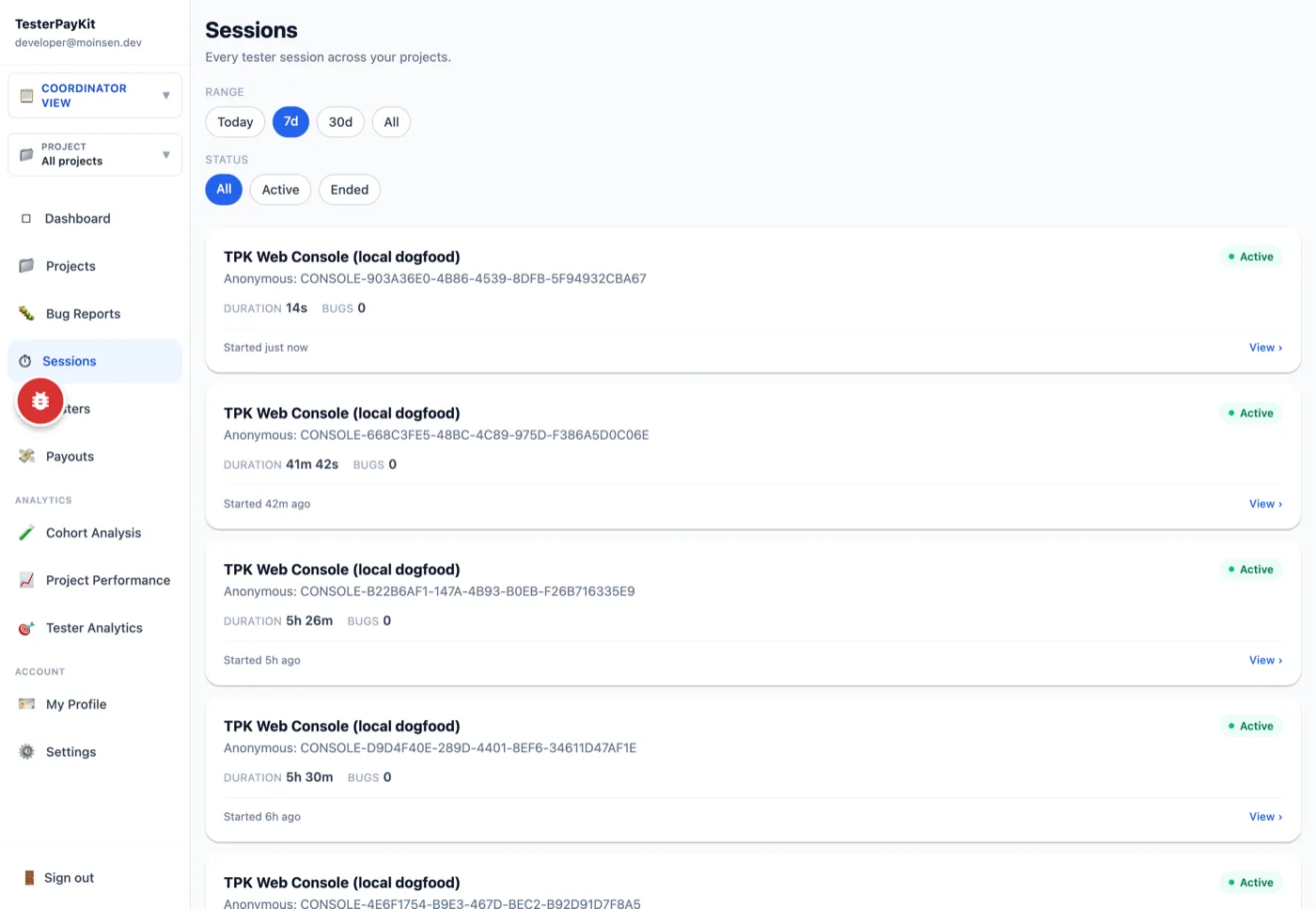
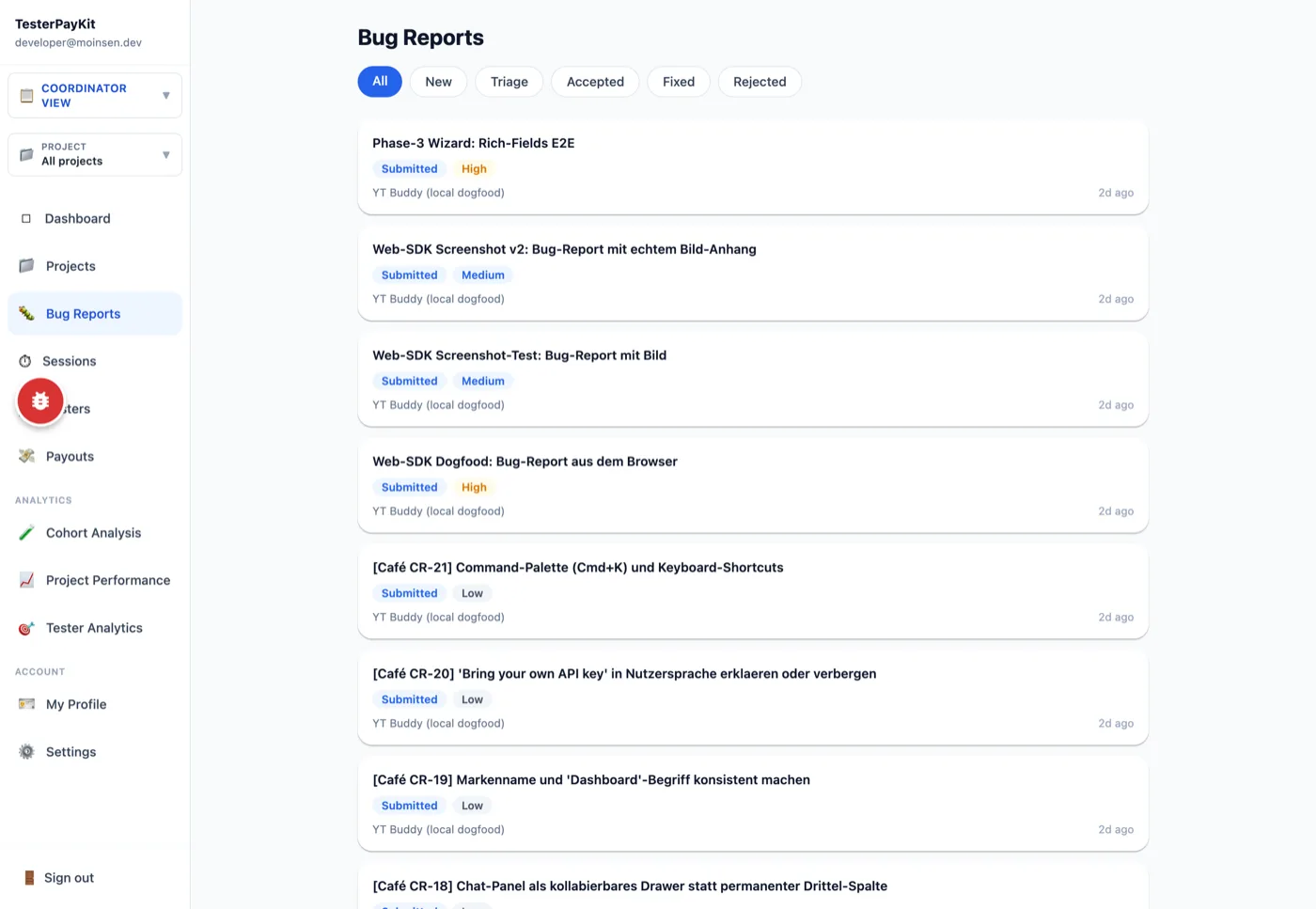
Screenshots from our own local instance, as of June 2026.
Everything you need to test your app with real users, without the enterprise price tag.
A curated pool of verified everyday testers — diverse devices, locations and generations, not the same power-users who already know your app.
Test on actual phones and tablets, not emulators. Feedback from the devices your users actually own.
Detailed bug reports and structured feedback in 24–48 hours. Ship with confidence.
GDPR-aligned by default. No PII or raw input content leaves the device unless a tester explicitly attaches it.
You pay only for sessions that pass: scored for quality, deduplicated, with intentional control-bugs planted to catch click-farmers. No retainer, no minimum.
Platform-access subscription. You set tester payouts. A transparent transaction fee keeps the platform running.
Bug reports with screenshots, widget-level annotations, device info and reproduction steps.
We're a studio that ships a lot of our own apps — and every one needs real testing before launch. Pro testers are expensive and rare; friends test once and ghost. So we built the tool we needed ourselves. Being customer number one isn't a tagline — it's where the product came from.
Dogfooded on our own apps before we opened it up. If it does not work for us, it does not ship.
Developers get affordable real-human testing. Everyday people get a fair way to earn flexible extra income — short tasks, transparent payout.
No invented numbers, no fake social proof. What is beta, we call beta. Pricing stays placeholder until it is final.
From the outside, TesterPayKit looks like a small SDK and a dashboard. Underneath, seven systems have to interlock — built, broken and rebuilt over nine months of daily dogfooding. That depth is the product.
Shake-to-report, session capture, breadcrumbs and an offline-safe outbox — native in Flutter, TypeScript/Expo and Swift, all held to a single wire contract.
Every bug arrives with its session: timeline, steps, device context, screenshots, screen recording. Testers do not write essays. Developers do not guess.
Job postings, applications, tester validation and reputation — the matching layer between apps that need testing and people who test.
Server-side payout calculation with per-project rules. Real money to real people — including the compliance homework that comes with it.
One web console, two worlds: developers manage projects, jobs and reports; testers browse, apply and earn.
A CLI and an MCP server feed bugs and sessions straight to AI coding agents — your agent reads the report and ships the fix in the same loop.
110+ endpoints carrying auth, roles, magic links, notifications and payouts — the part nobody notices until it breaks.
Could someone copy it? Sure — after they rebuild all seven. We will keep shipping in the meantime.
We build for indie developers shipping with AI tools. Compared against the two crowd-testing alternatives we get asked about most.
| TesterPayKit | UserTesting | TestFi | |
|---|---|---|---|
| Starting price | €0/month · pay-per-tester | $49–$150 / session | $1.99–$3.99 / tester |
| SDK integration | Optional (for deep telemetry) | None | None |
| AI-built app focus | Yes — Cursor, Claude Code, Lovable, Flutter | Generic | Generic |
| Auto-captured repro steps | Yes (breadcrumbs + crash context) | No | No |
| Paid testers from pool | Yes — DACH focus | Yes (US-centric) | Yes (12+ countries) |
| Hosting | EU (Hetzner) · GDPR-aligned | US | Unknown |
| Agentic fix loop (Claude Code) | Yes — tpk CLI + plugin | No | No |
Sources: vendor pricing pages (as of 2026-05). Feature claims from each vendor’s own marketing site at time of comparison.
Bring your own testers and pay only for the toolkit — or use our paid pool and pay per run. No seat quotas, no hidden payout cuts.
You already have people — staff, community, a Discord. Pay only for the platform that tracks, proves, and routes the testing. Nobody is paid through us, so there is no payout cut.
Bring your own testers — staff, community, friends.
For companies testing with their own people.
For agencies and larger in-house QA.
No testers of your own? We recruit and pay real everyday testers. You pay per test run — their time plus our margin, never less than we pay them.
Clear the Google Play 12-testers-for-14-days gate.
Know testing really happened — not hope it did.
Ship with a fix list, not a shrug.
The first 90 % is AI. The last 10 % — the bugs real thumbs find — is other builders, testing your app while you test theirs. Free while the beta lasts.
No credit card required · Free plan available · Cancel anytime